A small living room rarely fails because of its size. It fails because of what has been put in it, how that furniture sits, and how many things have no home. Get three decisions right — layout, colour and storage — and a compact sitting room will feel calm and easy to live in. Get them wrong and even a generous room can feel cramped. Work through them in that order, and you will avoid the usual mistake of buying more things to fix a room that already has too much in it.
Start with the layout, not the shopping
Before you buy anything, clear the room as far as you can and measure it properly. Note the position of windows, radiators, the chimney breast, plug sockets and the door swing. Then tape the footprint of your existing furniture onto the floor with masking tape, or use sheets of newspaper. It takes twenty minutes and saves a lot of money.
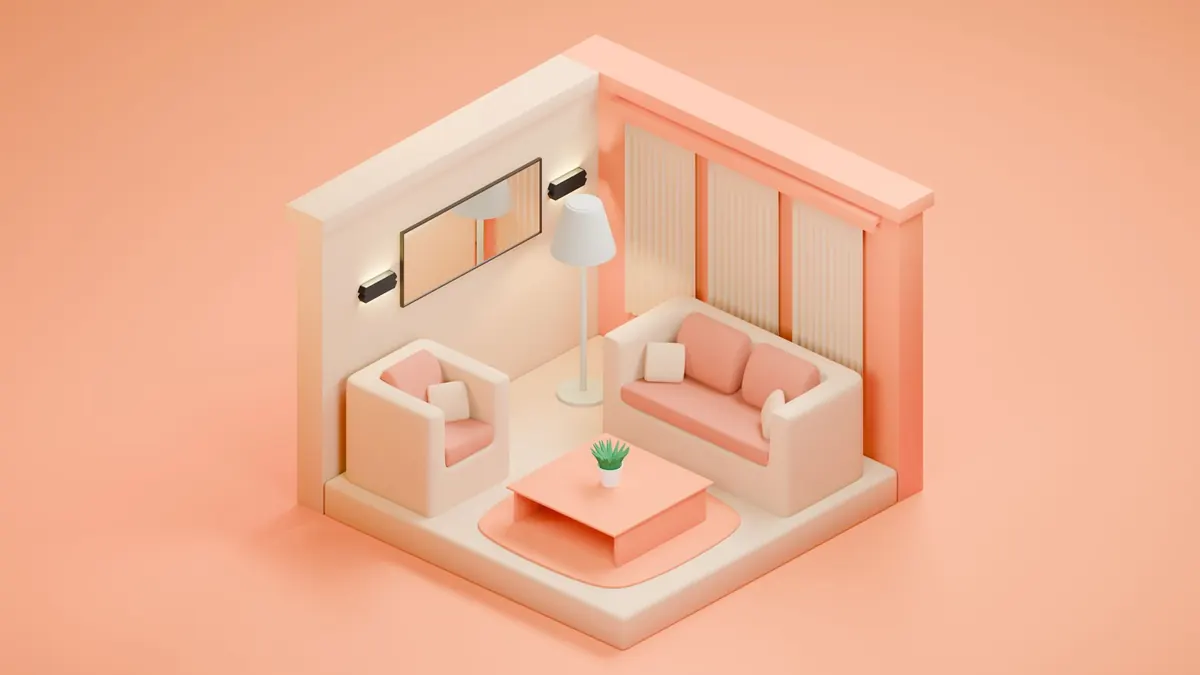
Two rules matter more than anything else. First, keep one clear route through the room. If a sofa, a coffee table and a lamp force people to step around one another, the space will feel smaller than it is; aim for a walkway of roughly 45–60cm between the main pieces. Second, decide on a focal point — a fireplace, a window with a decent view, or the television — and arrange the seating around it rather than pushing everything against the walls.
Pushing all the furniture back to the skirting boards is the most common mistake in small rooms. It creates a big empty middle and a ring of dead space around the edge. Instead, pull the sofa forward by 15–20cm if you can, angle an armchair towards the middle, and let the seating form a loose group. If the room is genuinely tiny, an L-shaped arrangement tucked into one corner usually gives you more usable seating than two sofas facing each other across a wide gap.
Get the colour scheme right
Pale walls do bounce light around, but an entirely white room can look flat and slightly clinical, especially in a north-facing space. Tonal layering works better than one uniform shade: pale walls, mid-tone upholstery, a darker floor, and one deeper accent that gives the eye somewhere to rest.
Work in tones, not just in light and dark
Choose two or three shades from the same family — a soft grey-green on the walls, a deeper version on a chimney breast or alcove shelving, a paler version in cushions. Depth reads as space. Contrast reads as edges, and too many edges chop a room into sections.
Treat the ceiling, floor and windows carefully
In a room with a low ceiling, keep the ceiling white or the same tone as the walls to blur the join. Continuing the same flooring from the hallway into the living room helps it feel part of a larger space, particularly if boards or tiles run in the same direction. Hang curtains as high and as wide as you reasonably can — a pole fitted just below the ceiling and extended past the window frame makes both the window and the wall look taller.
Use mirrors and light to stretch the room
One large mirror will do more than five small ones. Hang it opposite a window so it reflects daylight and the view, or lean it against the wall beside the fireplace. A mirror that only faces a blank wall or a lamp simply adds another object to the room. If you can, choose a plain frame in a tone close to the wall so the frame disappears and only the reflection registers.
Lighting is the other half of the illusion. Aim for three sources at different heights: an overhead light, a task light such as a floor lamp beside the sofa, and a softer glow from a table lamp or a pair of wall lights. Dimmable bulbs in a warm white are far kinder than a single bright pendant in the middle of the ceiling, and wall lights are especially useful in small rooms because they free up floor space. Push the light towards the corners rather than the centre; a lit corner feels further away.
Choose furniture that earns its place
Multifunctional furniture is not a gimmick in a compact room; it is how the room functions. A storage ottoman can serve as a coffee table with a tray on top and hold throws underneath. A bench with a lift-up lid beneath the window gives you seating and a home for board games. A slim console behind the sofa can hold lamps and books, and double as a desk when you need one.
- Look for visible legs or splayed frames. Furniture that shows floor beneath it feels lighter than a piece sitting flat on the ground.
- Think about depth, not just length. A shallower sofa can transform a narrow room.
- Choose a round or oval coffee table. It takes up less visual space and is easier to walk around.
- Swap a bulky armchair for a slim occasional chair, or use two small stools you can shift when you need the floor.
- Consider nesting tables instead of one large side table; they tuck away when they are not in use.
If a piece of furniture does not earn its floor space, it is costing you room.
Make storage work harder
Clutter is what makes a small room feel small, so storage belongs in the plan rather than arriving as an afterthought. Use the full height of the room: alcove shelves or a built-in unit either side of a chimney breast hold far more than a low sideboard and draw the eye upwards. Wall-mounted shelves above a sofa work well too, provided you leave comfortable headroom.
Then give everything a home, and make that home easy to reach. Baskets, lidded boxes and ottomans with lids are useful precisely because you can tidy in thirty seconds when someone knocks at the door. Two habits help more than any product: keep the surfaces — coffee table, mantelpiece, top of the media unit — as clear as you can, and keep one basket for the things that have no obvious place. If a cupboard is packed to the point where nothing can go back into it, it is not storage; it is a delay.
A weekend plan that makes a difference
If you would rather not redecorate, you can still change how the room feels in a couple of days.
- Empty the room as far as you can and measure it, including the door swing.
- Tape out a new layout and live with it for an evening before moving anything heavy.
- Clear one surface at a time and find a home for whatever stays.
- Reposition the mirror so it catches a window.
- Add a lamp in the darkest corner and swap any cool-white bulbs for warm ones.
- Move the rug so it sits under the front feet of the seating, tying the group together.
Small rooms respond well to one clear idea. Pick your focal point, group the seating around it, keep the palette tight, and be firm about what you keep on show. Do that, and the size of the room stops being the thing anyone notices.
Photo: Mahmoud Ramadan / Pexels